Harold

A hetero-structure laser diode model

SOI Hybrid Laser

simulated in Harold’s XY Laser Module

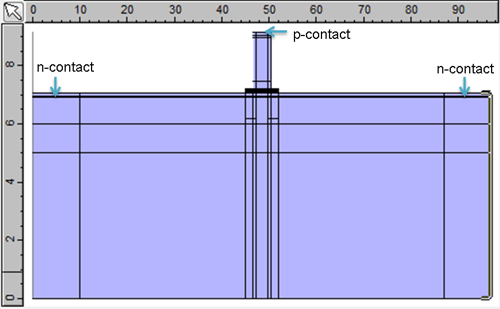
Harold’s XY Laser Module can be used to simulate Silicon-On-Insulator (SOI) hybrid lasers. In this example we simulate an SOI hybrid laser whose structure is shown schematically in the figure below.

SOI structure

Schematic of SOI hybrid laser structure simulated using Harold’s XY Laser Module

The structure has a III-V mesa region with an MQW AlGaInAs active region bonded to an SOI waveguide. The structure is ~70um wide in total with a 4um-wide central current channel, below which is an Si rib width surrounded by air channels on either side. The device was simulated in Isothermal mode (pulsed operation) from 0 to 500mA bias. 

XY Cross-section
2D XY Simulation – basic characteristics
2D XY Simulation – optical mode
2D XY Simulation – profiles/current spreading

XY Cross-section

The figure below shows the SOI hybrid epilayer structure and cross-section that were set up in Harold. Only the right-hand half of the cross-section had to be set up as the XY Laser Module allows one to define to the left-hand boundary as a symmetry plane, which can be used to reduce simulation times when modelling left-right symmetric structures. 

SOI cross section

(left) epitaxial layer structure at centre of cross-section as set up in Harold
with III-V layers on top of SOI waveguide layers,
(right) XY cross-section as set up in XY Laser Module – only right-hand half
is needed as left boundary is defined as a symmetry plane

Five epitaxial layer structures were used in total and assigned to the different slices of the cross-section in order to model the variations within the structure – the current channel, the Si rib, and air channels. An etch depth was defined for the last two slices (on the right) to achieve the overall ridge shape. 

2D XY Simulation – basic characteristics

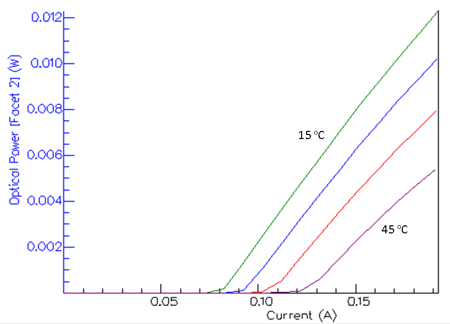
Like a Harold simulation, an XY simulation yields the basic characteristics of the device, such as the power-current relation and lasing wavelength. These two are shown in the figure below for the simulated SOI hybrid laser structure.

Lasing wavelength and power vs current bias

(top) lasing wavelength vs current bias and (bottom) power vs. current for simulated SOI hybrid laser

2D XY Simulation – optical mode

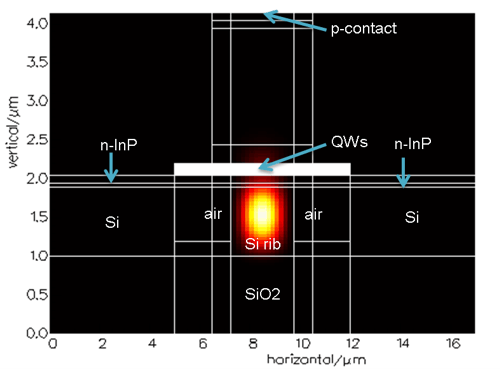
The XY Laser Module has a 2D effective index mode solver. For the simulated SOI hybrid cross-section it gave a familiar SOI keyhole-shaped mode. The figure below shows the portion of the mode which was used in XY Laser Module’s electrical/optical calculation algorithm (i.e. the part lying within III-V region only); the lower boundary corresponds to the top of the Si layer. 

SOI mode

Optical mode of SOI hybrid laser cross-section - only the part of the mode within the III-V region is shown here

2D XY Simulation – profiles/current spreading

In addition to basic device characteristics, an XY simulation yields numerous 2D profile results. A selection of those obtained from the SOI hybrid laser simulation are shown below. All profiles were taken at the maximum simulated bias (500mA). 

Electron density profile

XY profile of electron density in QWs – hole burning is evident in the centre where the mode intensity is greatest

Fermi potential profile

XY profile of Fermi potential of unconfined electrons – the effect of the lateral electric field can be seen in the direction of the slopes below the current channel

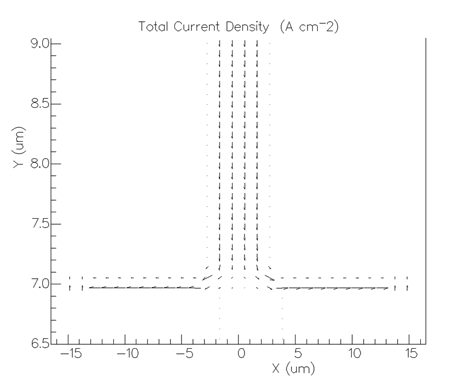
Harold’s XY Laser Module is particularly useful for studying lateral current spreading/leakage. The figures below show the horizontal and vertical components of the total current density in the III-V layers (as seen when looking down from the top-right of the structure). Together, the plots show the current flowing down the narrow current channel to the QWs, where there is a small amount of lateral spreading, then through and down to the bottom of the current channel, after which the current spreads laterally, equally in both directions, and then abruptly up to the n-contacts on either side. 

Current density profiles

(top) horizontal and (bottom) vertical components of total current density in III-V layers; the direction of flow - up/down, left/right - can be determined from the sign.